Motors
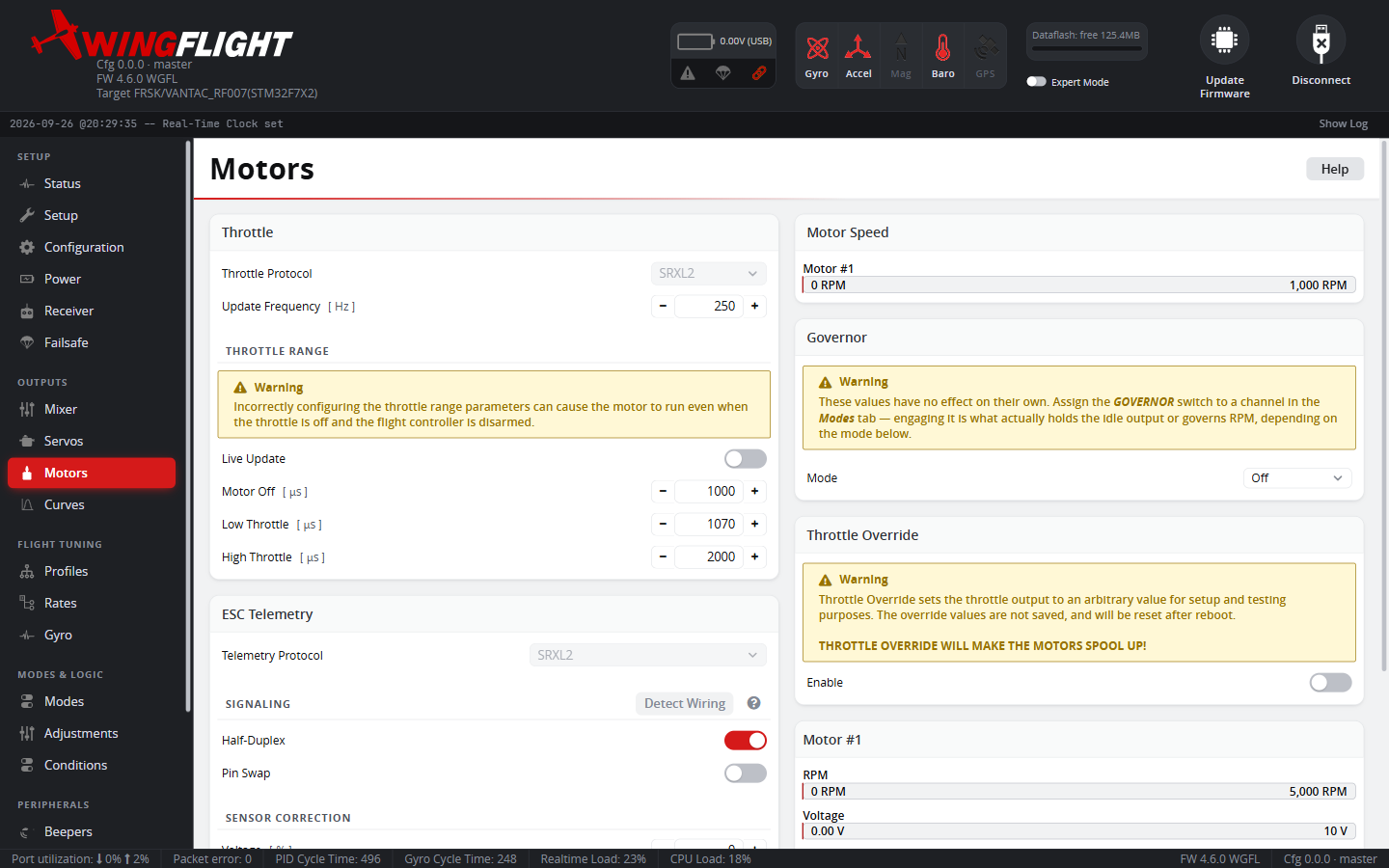
The Motors tab lets you test motor outputs individually (props off!) and configure motor-related output settings such as protocol and idle behavior. It also hosts the Governor section, which governs idle hold and RPM behavior separately from motor protocol/testing. In RPM Idle/Max mode, Idle Throttle Floor is the minimum powered idle output the governor is allowed to command below handover; in Throttle Idle mode, the same field is the fixed idle output.
Danger
Always remove propellers before testing motor outputs from this tab.
Protocol
Older ESCs expect plain PWM; most modern ESCs support a digital protocol like DShot, which is more precise and doesn't need the manual PWM-endpoint calibration below. Check what your specific ESC supports before switching.
For non-DShot ESCs, Unsynced PWM decouples the ESC update rate from the PID loop, running it instead at a fixed frequency you set (typically 50-250Hz -- most modern analog ESCs are happy at 250Hz).
SRXL2 ESC
Spektrum SRXL2 ESCs (e.g. Smart ESCs designed for the SRXL2 bus) use a single, bidirectional, single-wire UART connection for both throttle commands and telemetry -- there's no separate PWM/DShot signal wire and no separate ESC telemetry wire.
To use one, assign a spare UART the ESC: SRXL2 function on the Configuration tab. That one assignment is all that's needed: Protocol, ESC Telemetry Protocol, and Half-Duplex are all set to match automatically and lock (shown disabled, with a tooltip explaining why) so they can't drift out of sync with the port -- the firmware forces the same values on save regardless of what's shown here. To go back to a different ESC protocol, change the port's function on the Configuration tab rather than trying to change it from this tab.
With an SRXL2 ESC selected, the ESC Telemetry box gains an SRXL2 ESC section:
- Telemetry Interval: every how many throttle frames the ESC is asked for telemetry. 0 turns telemetry polling off. Default 7.
- Motor 2 Channel: for dual-motor Smart ESCs (e.g. the Spektrum
SPMXAE1020), the SRXL2 channel that carries the second motor. Motor 1 is
always channel 0. With a channel set, the motor count becomes 2 and the
mixer's second motor output (M2) drives it, so add a mixer rule for M2.
Leave it Off for a single motor (the default). CLI:
srxl2esc_motor2_channel.
Both take effect after Save and Reboot. Dual-motor Smart ESCs report no RPM and have no governor setting, so RPM filtering and the governor are not available with them.
Throttle endpoints (PWM-only)
For PWM/analog protocols, three raw PWM values calibrate the throttle range: Minimum Command (sent when the motor is stopped -- also what lets the ESC arm), Throttle Minimum (idle), and Throttle Maximum (full throttle). Get these wrong and a motor can spin even while disarmed, so it's worth using Realtime mode (applies changes immediately) paired with Throttle Override at 0%/1%/100% to directly verify Motor Off/Low/High before trusting the values -- rather than guessing and arming to find out.
RPM source
Both the Governor's RPM modes and the Gyro tab's RPM Filter need a real-time RPM reading -- from bidirectional DShot telemetry, an ESC telemetry sensor, or a dedicated frequency sensor. Configure whichever source your setup provides here so it's available to both.